
Fažana in the Roman period
Roman trail Vasianum Owing to its geographical position, proximity of the sea and fertile fields with Mediterranean crops, Fažana was an important economic center of Roman civilization, which in the Antiquity was under the administrative-political center of the Roman colony Pula (Pola).
Roman trail Vasianum
The area of Fažana comprises Runci cove in the south, coastal area of Peroj in the north and in the hinterland fertile land with olive groves and vineyards. In the very context of olive oil production, during the Roman domination Fažana occupied a central position on the Istrian coast. The proximity of the sea (enabling fishing) and protected Roman harbor where Roman merchant ships could berth made Fažana an ideal place to live, work and rest. The area of Fažana, just like entire Istria came under Roman rule in 177 BC, when the Romans conquered the main Histrian town of Nesactium – Vizače, but it was not until the mid-1st century AD that a more intensive settling or Romanization of the Istrian peninsula began. Among the many economic complexes and country estates of the Istrian peninsula during the Roman period, the ceramic-brick production complex in the historic core of Fažana is of special importance. The beginning of the figlina production activities can be dated to the late Augustan period. After Baton’s Uprising had been suppressed in 6-9 AD and having completely pacified the neighboring province of Illyricum, the Roman Empire entered a longer period of peace (Pax Iulia), enabling the prosperity of different activities. In this very historic context at the end of the Augustan period, the production of amphoras in Fažana began. They were used for transporting Istrian olive oil, which together with wine, were the main agricultural products of Istria in the Antiquity. The production of amphoras in Fažana continued until almost the end of the 2nd century. According to information obtained so far the ownership of Fažana’s workshop is relatively well known today. In the first half of the 1st century AD until 78 AD the workshop was owned by the senatorial family of Etruscan origin Lecanii. Its first known owner was Caius Laecanius Bassus praetor urbanus (high court official) in 32 AD and consul suffectus (high state official) in 40 AD. Since the last distinguished member of the Lecanii family, Caius Laecanius Bassus consul from 64 AD (who had the same name as his father) died somewhat before 78 AD without an heir, the workshop became the property of the Empire after his death. The amphoras produced in Fažana’s workshop, as can be confirmed by the stamps of Laecanius Bassus, were used to transport and export Istrian olive oil to the greater Danube region, such as present-day Hungary, Austria, Slovenia, then to the west, to north Italy along the Po river to Torino and Vercelli, as well as other parts of the Empire, even Rome.
✨Similar content

Small fishing academy Pilchard
Small fishing academy Pilchard – Fažana’s challenge in the fishing net of tradition

The Boathouse
The Presentation and Education Centre of the Brijuni National Park has been opened at the Boathouse.

Historical Roots of Olive Growing in Fažana
Where tradition, nature, and the story of olive oil come to life
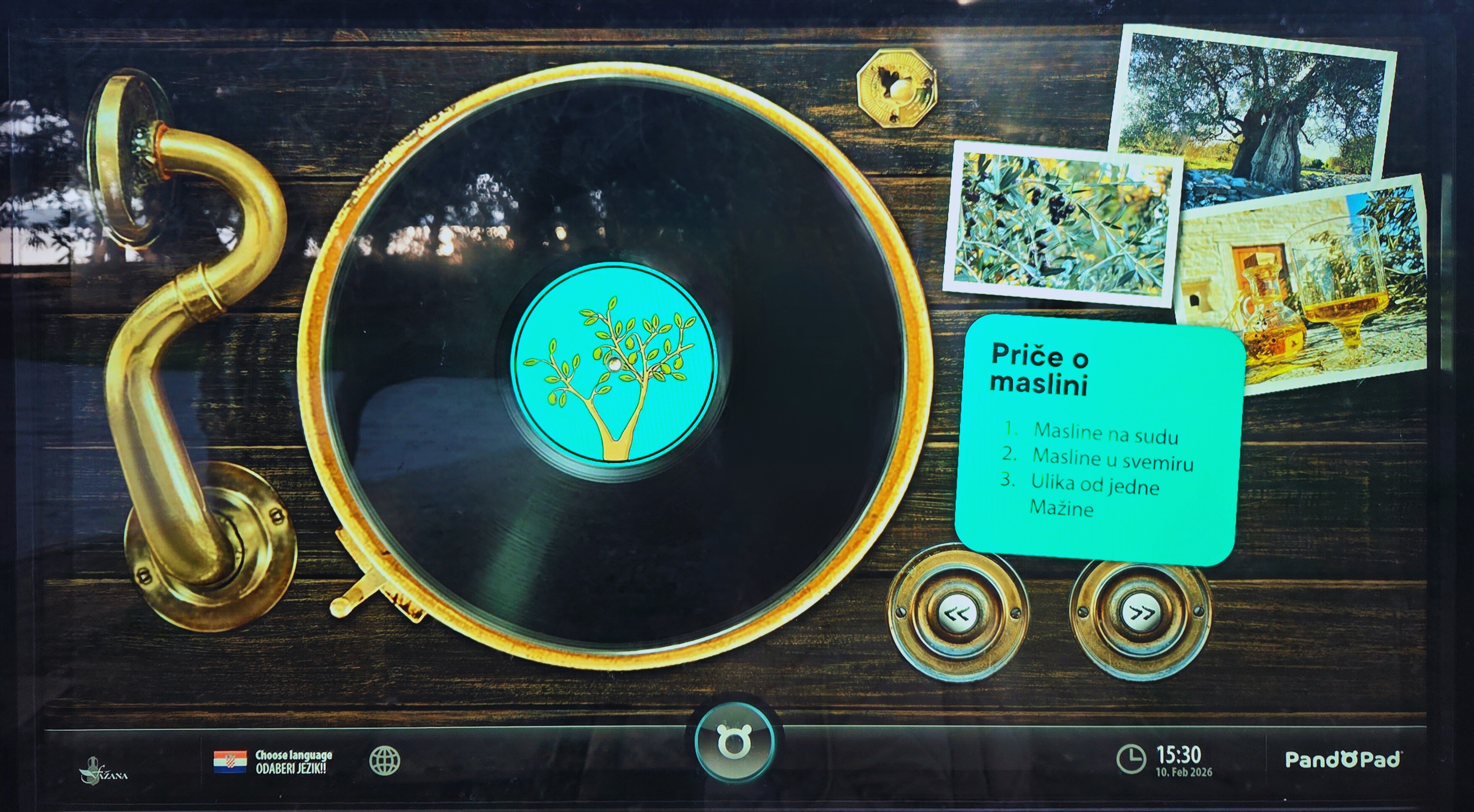
Audio stories about Fažana’s olives

What is hidden in the amphora?
Fažana is one of the few places in Istria that once had an amphora workshop.

Historical and cultural heritage
The archipelago of Brijuni is an extraordinary blend of natural, historical and cultural heritage.