
Guided Tour
Semi submarine Fažana
69%
MarineCoastalEducational
Ancient Port Cape Mede, Fažana (Beach San Lorenzo)
In ancient times the Fažana coast represented a perfect oasis for life as it is protected from the bura wind gusts.
In the 1st century, there was a maritime villa with a port, the remains of which were found at the end of the 19th century. The remains of the port were discovered in 2017 and studied in 2021 by the Archaeological Museum of Istria staff. In the research, various archaeological objects were found testifying to the economic power of the owners of the villa, but also of the entire area in the first centuries of the Roman period.
A hook-shaped breakwater has been preserved on the seabed, built of larger stone blocks of local limestone, some of which are as long as 3.2 meters. The width of the breakwater is from 3 to 6 meters.
Due to the rise of the sea level in the past, the breakwater is now submerged at a depth of 1 to 2 meters.
The hook-shaped breakwater is currently the only known example of its kind in Istria, and its broken structure was aimed to protect the port from the winds.
The location is an integral part of the Cultural routes of Fažana and the Roman trail Vasianum. Roman villa at Valbandon, the Roman ceramic-brick kiln in Fažana, traces of the Roman centuriation, and olive trees testify to the significance of Fažana in ancient Roman times.
Before sightseeing under the sea, keep in mind that in Fažana and in the surrounding area there are numerous archaeological remains from the Roman period. In Fažana there was one of the main producers of amphorae for the storage and transportation of olive oil. The famous and widely known Istrian olive oil was distributed in these amphorae. Throughout the first three centuries of our era, despite the variable production, which reached the peak during the first half and middle of the 1st century, Istrian olive oil was exported throughout the Empire.
Therefore, on the seabed, you can see replicas of the famous Fažana amphorae, as well as many natural sights.
Our sea is also home to a thriving marine environment. There are no guarantees as to what you might see while snorkelling (that’s part of the fun!), however these are some common species to keep an eye out for: piper gurnard, cuttlefish, greater weever, spider crab, warty or yellow crab. If you closely investigate the Roman breakwater, you will notice oysters, which were a common food for Romans. You might get a chance to spot the European thorny oyster, Noah’s ark shell, rough star shell, while egg cockles, the variegated scallop, the rosy razor clam, abalone or sea ears, and cockles like to hide in the sand. When they are not hiding in the shadow of larger stone blocks of the breakwater, juvenile fish species can be seen.
On the edge of the sand and in sea meadows, you can see the shells of the noble pen shell, the largest bivalve mollusc in the Adriatic. The noble pen shell is a strictly protected bivalve of the Adriatic and is currently an endangered species due to the drastic decline of its population.
This snorkeling location is also home to various types of starfish, which like to cover themselves with sand, and different types of sea slugs, from the very tiny ones to larger specimens such as sea hares whose upper head tentacles resemble hare’s ears – giving them their common name.
Sightseeing plan:
You enter the sea at the root of the breakwater (buoy 1) in the shallowest part. You start your sightseeing tour at the southern arm of the breakwater, 35 meters long (buoy 2). On the left side of the structure, you can see amphora replicas. Return to the position of the southern arm and swim to the top where the breakwater turns at a right angle to the north. This section is 25 meters long. Swim towards the head of the breakwater for 20 meters (buoy 3). From position 3 you swim back towards the shore.
Visit the site at your own risk!

The archipelago of Brijuni is an extraordinary blend of natural, historical and cultural heritage.

How to visit the Brijuni National Park?
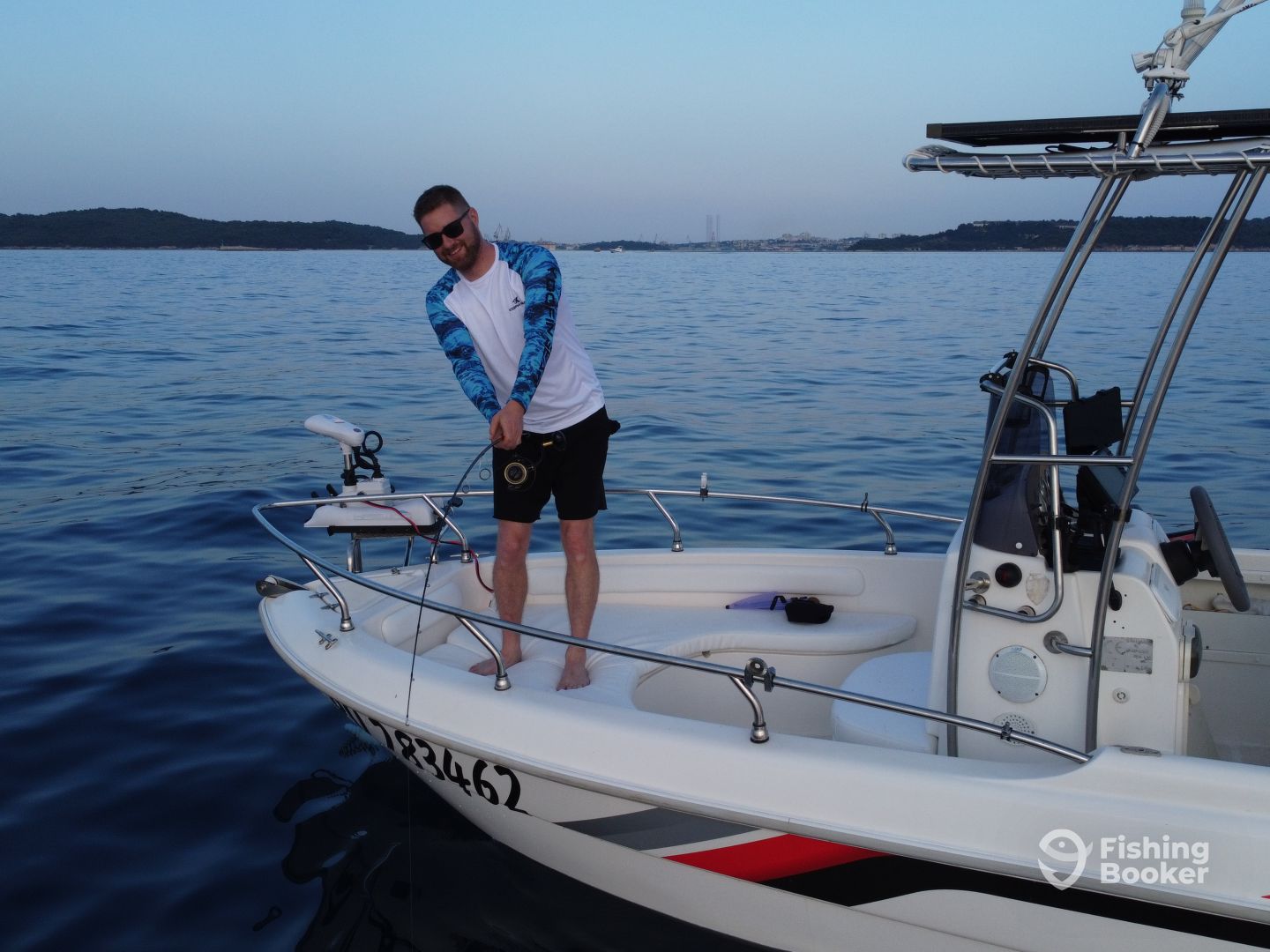
Experience authentic fishing in the Fažana waters with experienced local fishermen. Learn the basics of fishing, discover the best spots, and enjoy a relaxing time at sea.

Along the western Istrian coast there are several island groups among which the most interesting, the largest and most indented is the Brijuni island group with its 14 islands and islets covering and area of 7.42km2.

Brijuni National Park is an oasis of the magnificent harmony between man, animal and plant life.